What are you voting on?
There is one referendum question, printed on a single ballot, which reads: “Do you approve the text of the law revising Articles 87, paragraph ten; 102, paragraph one; 104; 105; 106, paragraph three; 107, paragraph one; and 110 of the Constitution, approved by Parliament and published in the Official Gazette on 30 October 2025 under the title ‘Provisions on the organization of the judiciary and the establishment of the Disciplinary Court’?”
By voting YES, the voter expresses the will to APPROVE the constitutional reform passed by Parliament.
By voting NO, the voter expresses the will to NOT APPROVE the constitutional reform passed by Parliament.
Who votes abroad?
The following vote abroad by mail:
- voters registered with AIRE residing in countries where local conditions allow voting by mail;
- voters temporarily abroad for at least three months for work, study, or medical treatment who submitted their request to vote abroad to their municipality of electoral registration by 18 February 2026, as well as their cohabiting family members abroad, if they have opted to vote.
How to vote?
Voting takes place by mail, in accordance with Law No. 459 of 27 December 2001 and Presidential Decree No. 104 of 2 April 2003. In particular:
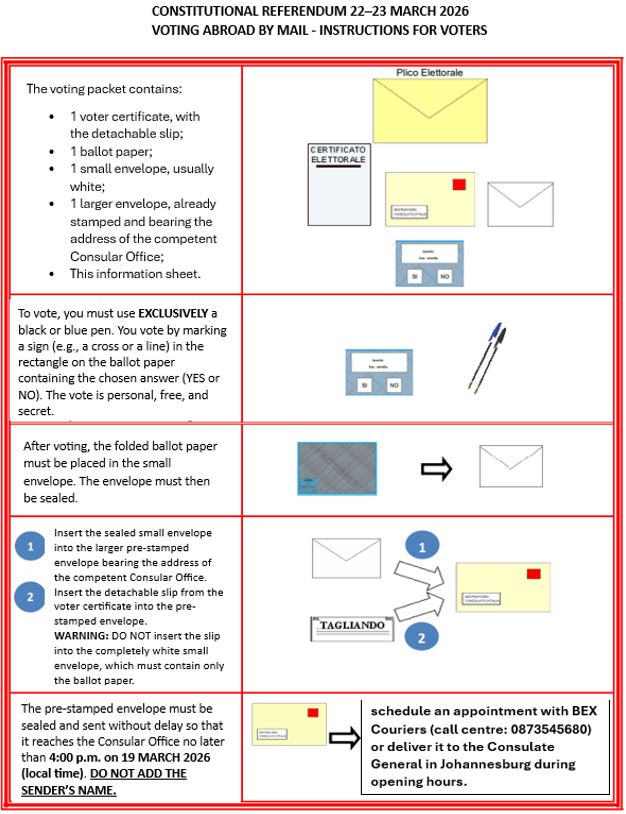
a) Consular offices send each voter a package containing:
- the electoral certificate (i.e., the document certifying the right to vote);
- a ballot paper;
- a small envelope (normally white);
- a larger prepaid envelope bearing the address of the competent diplomatic/consular office;
- this information sheet.
b) The voter casts their vote by marking a sign (e.g., a cross or a line) in the box on the ballot containing the word YES or NO, using EXCLUSIVELY a blue or black pen.
c) After voting, the ballot must be placed inside the small envelope, which must be carefully sealed and must contain only the ballot paper.
d) In the larger pre-stamped envelope (bearing the address of the competent diplomatic/consular office), the voter must place the electoral slip (after detaching it from the electoral certificate along the indicated perforated line) and the sealed small envelope containing the completed ballot.
e) The prepared prepaid envelope must be mailed without delay and in any case so that it reaches the competent diplomatic/consular office no later than 4:00 p.m. (local time) on THURSDAY, 19 MARCH 2026.
f) Ballots received after the above deadline cannot be counted and will be destroyed.
W A R N I N G
- No identifying marks must appear on the ballot, on the small white envelope, or on the electoral slip.
- The sender’s name must not be written on the pre-stamped envelope.
- The small white envelope and the ballot must be returned intact.
- Voting is personal, free, and secret. Voting more than once is prohibited; anyone who violates the relevant provisions is subject to the penalties provided by law. Article 18 of Law 459/2001 provides:
“1. Anyone who, abroad, commits any of the offences provided for in the Consolidated Law containing provisions for the election of the Chamber of Deputies, pursuant to Presidential Decree No. 361 of 30 March 1957, as amended, shall be punished under Italian law. The penalties provided for in Article 100 of the aforementioned Consolidated Law, in the case of voting by mail, shall be doubled.
Anyone who, in elections of the Chambers or in referendums, votes both by mail and at the polling station of their last registration in Italy, or votes more than once by mail, shall be punished with imprisonment from one to three years and a fine from 52 euros to 258 euros.” - The voter is required to personally safeguard the electoral materials sent by the Embassy or Consulate and it is strictly forbidden to hand over the electoral materials to third parties.